The next book from the 1001 list I chose to read was Secret History by Donna Tartt. I read The Goldfinch and really enjoyed it.
1. School books. I am drawn to this book because it takes place in a school, which is one of my favorite tropes. I love Hogwarts and stories of brilliant scholars finding their place in the world. There seems to be only two types of school book heroes: the genius or the fuck up. Why do we never hear the story of the moderate scholar who is neither brilliant nor tragic? I suppose they don’t make for engaging stories. This book immediately reminded me of Leaving the Atocha Station by Ben Lerner and the movie Kicking and Screaming.
2. This book is structured somewhat similarly to The Goldfinch in that it starts off with what ends up happening. Why do you think this book does that and why do you think Donna Tartt writes this way (does her other book, The Little Friend, follow suit)? My suggestion is it establishes the concept of fate. “It was an entirely random decision which, as you will see, turned out quite fateful” (9). By placing the consequences before their actions, the story becomes one that is inescapable. We already know what will happen. We know because it has already happened, so is the past actually fate? As opposed to a story that is told chronologically that could have infinite possibilities of endings, we are told at the beginning how this story will end. It mirrors life in the way that we all know what is in store for us: death. The story is how we get there.
3. The narrator, Richard, is invited to dinner by the twins and ends up having to deal with the package deal. Why did Richard freak out? Because he was feeling overwhelmed, hungover, embarrassed. He didn’t know if he’d made the right choice, he didn’t know if he liked the group of students in his program. He didn’t feel as if he had a choice. And then there was the bloody lamb chops. Bunny eating voraciously from the lamb, symbolically (albeit more sacrificially Judeo-Christian). I was reminded of Professor Julian’s lecture about the lure of losing the self through ancient rites bringing out the animal side. He spoke of the Greek’s vision of beauty: “bloody, terrible things are sometimes the most beautiful.” And the desire “to lose control completely…. To throw off the chains of being for an instant, to shatter the accident of our mortal selves” (42). I thought, maybe this is what is going to happen, some kind of pagan ritual. I thought about the toast Julian poses and his pupils echo back: “Live forever” (91). And I also remembered the rumor that had been spread that this particular group of students “worship the fucking Devil” (74). Donna Tartt expertly weaves in the specter of death as they casually mention a cemetery that they want to visit.
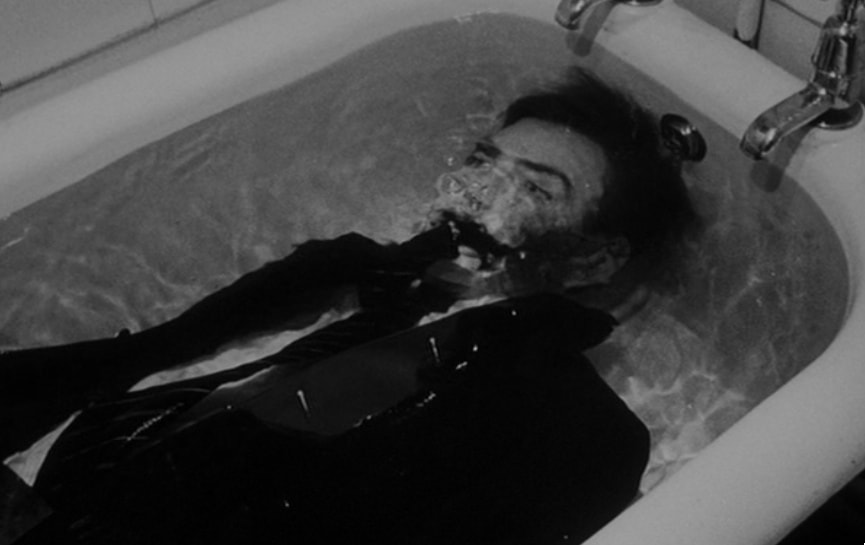
4. Another reason for putting the ending first is to create suspense. If you know that Bunny is going to be murdered, every time you see him, the scene is imbued with a sense of dread and precognition of his death. You begin to enjoy hating him, knowing that he will get his just desserts. One of my favorite suspense movies is Les Diaboliques in which a murder also happens. There is a scene in The Secret History that echoes the movie, making me wonder if Donna Tartt may have seen it. After Bunny is murdered, Richard has a dream: “The tub was ... full of water, and Bunny, fully clad, was lying motionless at the bottom of it. His eyes were open and his … pupils were different sizes – one larger and black, the other scarcely a pinpoint. The water was clear, and very still. The tip of his necktie undulated near the surface” (295).
1. School books. I am drawn to this book because it takes place in a school, which is one of my favorite tropes. I love Hogwarts and stories of brilliant scholars finding their place in the world. There seems to be only two types of school book heroes: the genius or the fuck up. Why do we never hear the story of the moderate scholar who is neither brilliant nor tragic? I suppose they don’t make for engaging stories. This book immediately reminded me of Leaving the Atocha Station by Ben Lerner and the movie Kicking and Screaming.
2. This book is structured somewhat similarly to The Goldfinch in that it starts off with what ends up happening. Why do you think this book does that and why do you think Donna Tartt writes this way (does her other book, The Little Friend, follow suit)? My suggestion is it establishes the concept of fate. “It was an entirely random decision which, as you will see, turned out quite fateful” (9). By placing the consequences before their actions, the story becomes one that is inescapable. We already know what will happen. We know because it has already happened, so is the past actually fate? As opposed to a story that is told chronologically that could have infinite possibilities of endings, we are told at the beginning how this story will end. It mirrors life in the way that we all know what is in store for us: death. The story is how we get there.
3. The narrator, Richard, is invited to dinner by the twins and ends up having to deal with the package deal. Why did Richard freak out? Because he was feeling overwhelmed, hungover, embarrassed. He didn’t know if he’d made the right choice, he didn’t know if he liked the group of students in his program. He didn’t feel as if he had a choice. And then there was the bloody lamb chops. Bunny eating voraciously from the lamb, symbolically (albeit more sacrificially Judeo-Christian). I was reminded of Professor Julian’s lecture about the lure of losing the self through ancient rites bringing out the animal side. He spoke of the Greek’s vision of beauty: “bloody, terrible things are sometimes the most beautiful.” And the desire “to lose control completely…. To throw off the chains of being for an instant, to shatter the accident of our mortal selves” (42). I thought, maybe this is what is going to happen, some kind of pagan ritual. I thought about the toast Julian poses and his pupils echo back: “Live forever” (91). And I also remembered the rumor that had been spread that this particular group of students “worship the fucking Devil” (74). Donna Tartt expertly weaves in the specter of death as they casually mention a cemetery that they want to visit.
4. Another reason for putting the ending first is to create suspense. If you know that Bunny is going to be murdered, every time you see him, the scene is imbued with a sense of dread and precognition of his death. You begin to enjoy hating him, knowing that he will get his just desserts. One of my favorite suspense movies is Les Diaboliques in which a murder also happens. There is a scene in The Secret History that echoes the movie, making me wonder if Donna Tartt may have seen it. After Bunny is murdered, Richard has a dream: “The tub was ... full of water, and Bunny, fully clad, was lying motionless at the bottom of it. His eyes were open and his … pupils were different sizes – one larger and black, the other scarcely a pinpoint. The water was clear, and very still. The tip of his necktie undulated near the surface” (295).
5. About half way through the book, we have come back to when Bunny is actually murdered and I begin to worry that there is nothing else for the plot to deal with and the rest of the book will be circular filler. I figure that there will be fallout to deal with and I begin to worry about Richard. He is the only one of the students without a solid alibi and he has always been a bit of an outsider. I wonder if he was manipulated to take the fall in the first place. The rest of the book can then be how he becomes embroiled in the plot to frame him, and maybe how he extricates himself, or fails to do so. Of course, in books such as Crime and Punishment, the crime happens at the very beginning of the book and the rest is the punishment. And to confirm this suspicion, Dostoevsky is name dropped and Crime and Punishment itself is quoted.
6. Why does Richard do what everyone tells him all the time? At first, he does it to fit in. He wants to belong even if it is to a rag-tag group like the Greek Geeks (I made that name up). “At one time I had liked the idea, that the act, at least, had bound us together; we were not ordinary friends, but friends till-death-do-us-part,” Richard says. “Now it made me sick, knowing there was no way out. I was stuck with them, with all of them, for good” (460). It is ironic that he had once felt obligated to follow along in order to belong, but now that he was involved, there was no escape.
7. If suspense is like having a heavy anvil tied over one’s head, what happens when the tension is lessened and the anvil drops? I stopped being as interested in the events after Bunny’s death. I stopped caring what would happen and kind of just wanted the story to be over. In a sense, my experience was Richard’s. He also just wanted everything to be resolved, but it had to play out to the end. Richard has been changed by his experience, as evidenced by the later scene in which he eats the lamb chop: he is no longer disgusted by it.
8. Why is this a book you must read before you die? It is very literary, referencing other things, more than just itself. At times the book feels like it is merely taking us from point A to point B in the most skillful way possible. We don’t get to know the characters but we want to. It’s a book-lovers’ book. What is there actually to like? The language, the references, the structure, the symbolism. What does the title refer to? The history of Bunny’s death? The history of Richard’s life? The secret of the school? The past is not fate; it is not meant to be repeated. There is a reason we don’t speak Greek and have bacchanals: it doesn’t work. The secret of history is that it is over and if we try to relive it we are doomed to make the same mistakes.
There is a definite age range for this book. A 25 year old might be enamored with the characters and commiserate with the youthful experiences, but an older reader sees more of their flaws. A 50 year old might relate best to Dr. Roland. You might agree that Richard should never get involved with these people.
This is a book to get drunk on. As a youth, the drunkenness and the results are inextricably linked. You will voraciously gobble up all the exquisite text, become enthralled with the exclusive elite. You will want to infiltrate the small band of friends and feel nostalgic when it all passes. But as an older reader, the book, like drink, will more likely leave you sad and sick, regretful. You will parse the error of the characters' ways; you will want to impart wisdom. You will feel the tragedy and hope for sobriety in the future.
6. Why does Richard do what everyone tells him all the time? At first, he does it to fit in. He wants to belong even if it is to a rag-tag group like the Greek Geeks (I made that name up). “At one time I had liked the idea, that the act, at least, had bound us together; we were not ordinary friends, but friends till-death-do-us-part,” Richard says. “Now it made me sick, knowing there was no way out. I was stuck with them, with all of them, for good” (460). It is ironic that he had once felt obligated to follow along in order to belong, but now that he was involved, there was no escape.
7. If suspense is like having a heavy anvil tied over one’s head, what happens when the tension is lessened and the anvil drops? I stopped being as interested in the events after Bunny’s death. I stopped caring what would happen and kind of just wanted the story to be over. In a sense, my experience was Richard’s. He also just wanted everything to be resolved, but it had to play out to the end. Richard has been changed by his experience, as evidenced by the later scene in which he eats the lamb chop: he is no longer disgusted by it.
8. Why is this a book you must read before you die? It is very literary, referencing other things, more than just itself. At times the book feels like it is merely taking us from point A to point B in the most skillful way possible. We don’t get to know the characters but we want to. It’s a book-lovers’ book. What is there actually to like? The language, the references, the structure, the symbolism. What does the title refer to? The history of Bunny’s death? The history of Richard’s life? The secret of the school? The past is not fate; it is not meant to be repeated. There is a reason we don’t speak Greek and have bacchanals: it doesn’t work. The secret of history is that it is over and if we try to relive it we are doomed to make the same mistakes.
There is a definite age range for this book. A 25 year old might be enamored with the characters and commiserate with the youthful experiences, but an older reader sees more of their flaws. A 50 year old might relate best to Dr. Roland. You might agree that Richard should never get involved with these people.
This is a book to get drunk on. As a youth, the drunkenness and the results are inextricably linked. You will voraciously gobble up all the exquisite text, become enthralled with the exclusive elite. You will want to infiltrate the small band of friends and feel nostalgic when it all passes. But as an older reader, the book, like drink, will more likely leave you sad and sick, regretful. You will parse the error of the characters' ways; you will want to impart wisdom. You will feel the tragedy and hope for sobriety in the future.

 RSS Feed
